Blog > On Boneless Sofas
Newsletter: On Boneless Sofas

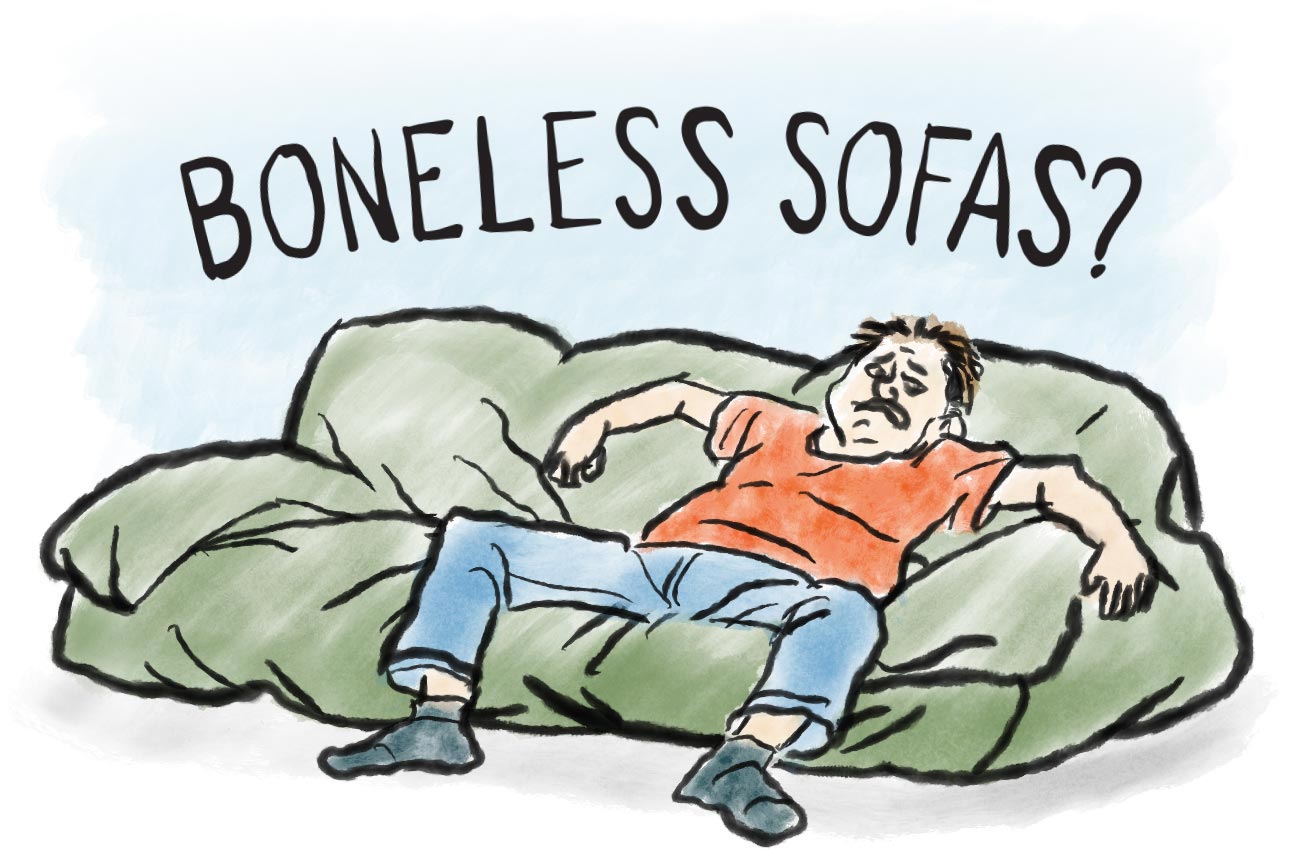
Every few years, the furniture world decides it has reinvented the sofa. This time around, it's the boneless sofa — a bold new idea that asks: "What if we made furniture, but a little bit less?"
You've probably seen one in your local membership warehouse (right next to the three-gallon jar of pickles) or pitched in one of those social media ads that follow you around with the tenacity of a housefly that won't take a hint.
You know the look: giant cushions, soft corners, no visible structure, legs, or anything. It's less "sofa" and more "overly confident bean bag."
How are they made? Foam, fabric, & a dream.
They lack a rigid frame (a.k.a. the "bones", although the implications of this terminology honestly creep me out) as well as any manner of traditional suspension system.
To be fair, boneless sofas may feel great at first. They can be soft and cozy, often with generous proportions that can be great for lounging. But time has a way of revealing reality. The foam cushions compress and wander. The corners cave in. The whole thing gradually degrades into a cruel caricature, like The Picture of Dorian Gray if the subject were a piece of furniture rather than a hedonistic rake.
In defense of (ugh) "bones."
A traditional, high-quality sofa begins life long before foam and fabric enter the picture. A stack of lumber — not particle board, not OSB, not "engineered" anything — is cut, fitted, and assembled by hand. The frame's joinery is fortified with dowels, glue, and blocking to stabilize the structure. Corners and stress points are overbuilt — the opposite of minimalism, which aids in long-term survival.
Equally important for durability are sag-resistant suspension components, which provide comfort while delivering lasting support beneath the cushions. While high-grade foam in seat cushions is essential for a great sofa, it alone is insufficient.
A boneless sofa may have a lifespan of a few years; a well-constructed frame can continue functioning for decades.
Why are boneless sofas (suddenly) popular?
Because they're cheaper and easier to make, of course.
Building good frames and integrating durable suspensions is a difficult, costly process requiring lots of materials and hours of labor from skilled craftspeople. Worse, customers don't see the frame — it's out of sight — so it's difficult for someone outside of the industry to understand what it does and why it matters.
But a well-made, traditionally-constructed sofa is capable of delivering style and comfort long after a boneless pile of foam has become disposable.
Quick addendum:
While fully boneless sofas are most commonly found at the bottom half of the market, there are two other types of sofa that can be found at mid and high-end price points. I'm not sure that either of these categories has agreed-upon names within the industry, but let's call them "foam suspension sofas" and "bone-ish sofas."
Foam suspension sofas: This is a sofa with a frame, either internal or external, but lacks any suspension for the seat. It relies entirely on a very thick foam base to carry your weight. While these are definitely more substantial than a boneless product, the lack of a firm suspension base is likely to create durability problems down the road.
Bone-ish sofas: These sofas have a portion of a traditional frame and some sort of seat suspension, but instead of a rigid frame member for the backrest, they rely on a pliable foam or suspending member to keep back pillows in place. The issue with this method of construction is that these methods of support will stretch and degrade with time, resulting in loss of back support and eventual failure.
These two construction methods are being used by high-end brands on a number of product lines. I won't list them here because ✨lawsuit✨ but don't let their initial comfort *ahem* cloud your judgment.

RELATED POSTS
Newsletter: On Never Finding A Color Match
What's The Best Kind Of Sofa For Little Kids?
Should I Put Casters On My Sofa?